Education · Gemology · 15 October 2026 · 2 min read
The Evolution of the Cut: From Point to Brilliant
By Trinity Diamants
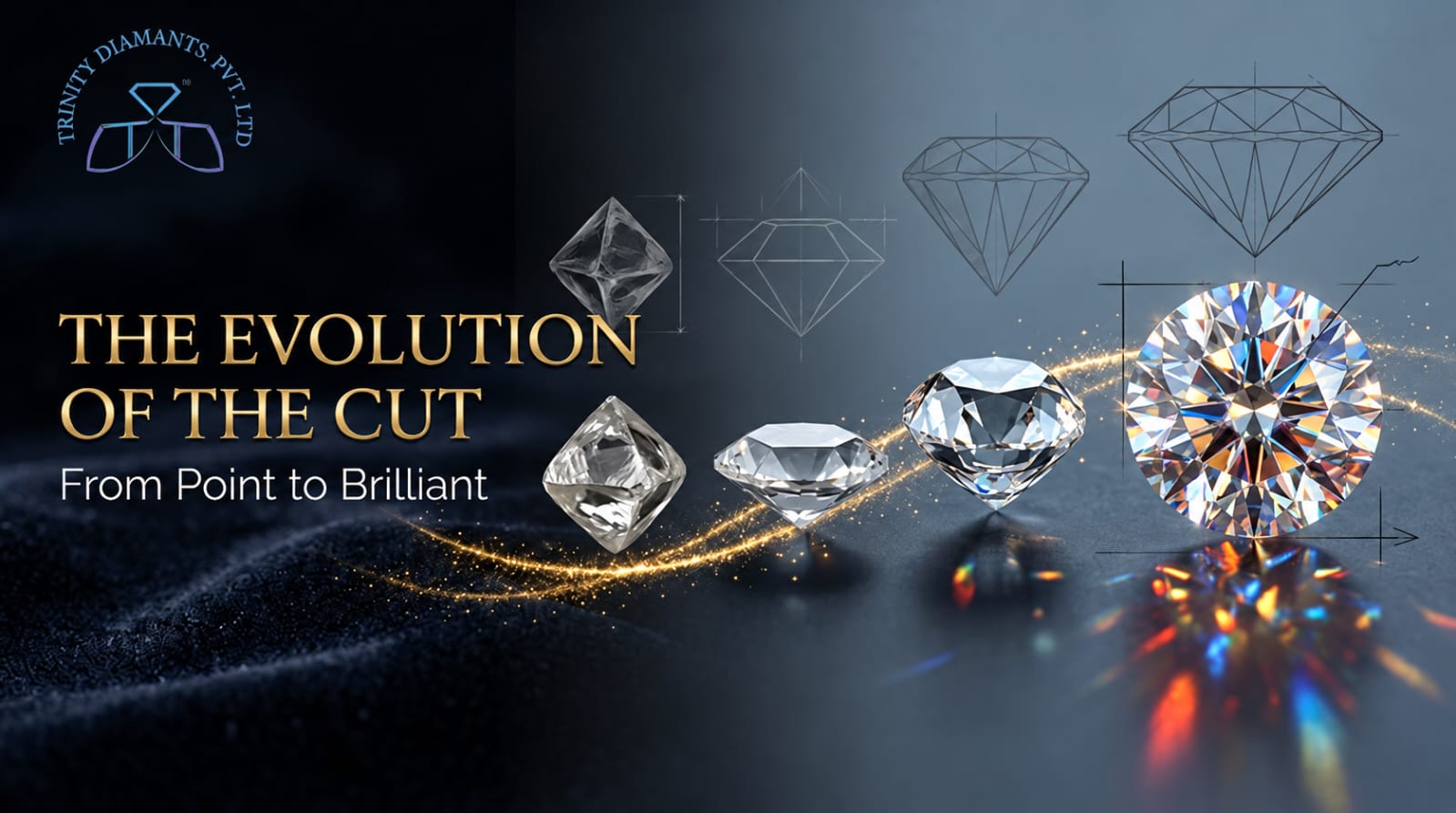
For centuries, diamonds were admired not for their sparkle, but for their unmatched hardness and natural geometric symmetry. The journey from rough octahedral stones to the mesmerizing, light-refracting gems we see today is a story of craft, geometry, and technological innovation.
The Early Days: Point and Table Cuts
In the Middle Ages, lapidaries possessed few tools capable of shaping a diamond. Instead of faceting, early craftsmen simply polished the natural faces of octahedral diamond crystals, creating what is known as the Point Cut.
By the 15th century, cutters began cleaving or grinding off the top corner of the octahedron to create a flat facet on top. This created the Table Cut, marking the first major structural modification to a diamond's shape:
- Point Cut: Followed the natural eight-faced octahedron crystal habit with minimal alteration.
- Table Cut: Introduced a flat top facet (table) and occasionally a small culet at the bottom.
- Rose Cut: Developed in the 16th century, featuring a flat base and a dome topped with triangular facets.
The Quest for Fire: Old Single and Old Mine Cuts
As lapidary tools advanced in the 17th and 18th centuries, craftspeople realized that adding more facets directly increased a stone's light return and dispersion. The Mazarin Cut (a 34-facet cushion shape) evolved into the Peruzzi Cut, which boasted 58 facets—the foundational facet count for modern brilliant cuts.
In the 19th century, the Old Mine Cut and Old European Cut took center stage. Hand-cut by candlelight, these styles featured higher crowns, smaller tables, and larger culets, creating deep, dramatic flashes of light rather than intense surface brilliance.
"Historical cuts were shaped to maximize color and fire under soft candlelight, prioritizing weight retention and character over uniform symmetry."
The Birth of the Modern Brilliant Cut
The modern era of diamond cutting arrived in 1919, when mathematician and gemologist Marcel Tolkowsky published his landmark dissertation, Diamond Design. Using mathematical calculations based on light refraction and reflection, Tolkowsky outlined the exact angles and proportions needed to maximize both brilliance (white light reflection) and fire (spectral color dispersion).
Today’s standard round brilliant cut refined Tolkowsky's principles into a precise arrangement of 57 or 58 facets, standardizing cut quality and fire across the jewelry world.
Discovering Your Ideal Diamond Cut
Whether you are drawn to the fiery romanticism of an Old European cut or the precision brilliance of a modern round cut, understanding cut history helps you choose a stone that reflects your personal aesthetic.
Explore our collections to see how modern craft honors centuries of lapidary heritage, or book an appointment with our experts to find your perfect brilliant cut.