Heritage · Famous Diamonds · 25 October 2026 · 2 min read
Famous Stones: The Legendary Histories of The Hope and The Koh-i-Noor
By Trinity Diamants
Throughout human history, few gemstones have commanded awe, triggered empires to clash, and captured the imagination quite like legendary diamonds. Beyond their sheer mineral rarity and brilliance, their enduring fascination lies in the human drama woven into their facets over centuries.
The Hope Diamond: Mystique, Royalty, and Myth
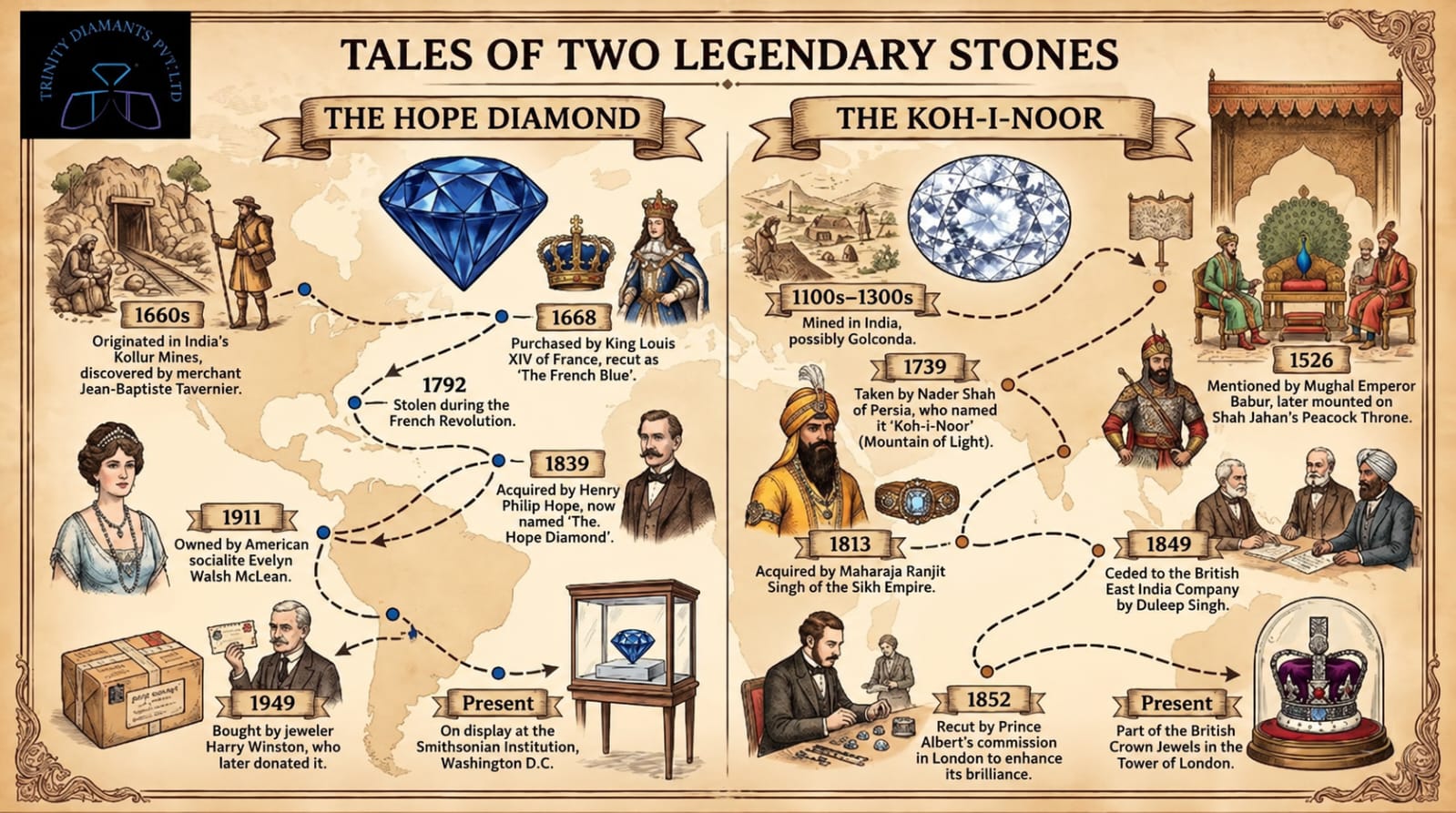
Originating from the fabled Kollur mines of Golconda, India, the Hope Diamond is celebrated for its extraordinary 45.52-carat weight and rare deep steely-blue hue. Before it became an emblem of American philanthropy, it carried a turbulent royal legacy.
- The French Blue: Acquired in India by gem merchant Jean-Baptiste Tavernier in the 17th century, the rough stone was recut for King Louis XIV into the magnificent Bleu de France (French Blue), a centerpiece of the French Crown Jewels.
- Revolution and Disappearance: Snatched during the chaos of the French Revolution in 1792, the gem resurfaced years later in London, re-cut to disguise its royal origins and acquired by banker Henry Philip Hope, whose name it bears today.
- The Modern Legacy: While 20th-century sensationalism popularized tales of a curse following its owners—most notably Evalyn Walsh McLean—the stone found its peaceful final resting place in 1958, donated by jeweler Harry Winston to the Smithsonian Institution.
The Koh-i-Noor: Sovereign Power and Imperial Conquest
Meaning "Mountain of Light" in Persian, the Koh-i-Noor is perhaps the most politically significant gemstone ever recorded. Unlike many gems whose value is purely ornamental, possession of the Koh-i-Noor was historically treated as an undisputed talisman of imperial dominion.
Passed across centuries through the hands of the Kakatiya dynasty, the Mughal emperors, Nader Shah of Persia, the Durrani Empire of Afghanistan, and Maharaja Ranjit Singh of the Sikh Empire, its journey mirrors the shifting borders of South Asia.
"If a strong man were to throw four stones, one north, one south, one east, one west, and a fifth stone up into the air, and if the space between them were to be filled with gold, all would not equal the value of the Koh-i-Noor." — Persian historian describing the gem's legendary stature.
When the East India Company annexed Punjab in 1849 via the Treaty of Lahore, the diamond was surrendered to Queen Victoria. At the Great Exhibition of 1851, Victorian onlookers felt its traditional Indian rose cut lacked the optical fire popular in Europe. Prince Albert subsequently commissioned a re-cut in 1852, reducing the stone from approximately 186 carats to its modern 105.6-carat oval brilliant form.
The Timeless Allure of Iconic Diamonds
The Hope and the Koh-i-Noor remind us that every diamond is a physical artifact of deep geological time and cultural history. While their pasts are tied to dynasties and myths, their lasting impact continues to inspire high jewelry design and modern lapidary arts.
Discover the artistry and science of natural stones firsthand. Explore our bespoke creations, or speak with our master gemologists to begin crafting your own timeless family heirloom.